You know your Google Business Profile matters. You've known for a while. You've also got three or four dentists in the building, and you've had a nagging feeling that each of them should be showing up on Google Maps, too. Then a patient shows up, a crown needs redoing, payroll is due, and it slides to next month. Again.
You're not alone, and you're not wrong to feel it's confusing. Google Business Profile for dentists has its own rules, and some of them changed in 2026. This is the plain-English playbook for 2027: why the profile still matters, how each doctor gets a profile and a page of their own, who should own it, and how to get reviews without breaking Google's new rules.
Google profiles and reviews by the numbers
97%
of consumers read reviews when choosing a local business
BrightLocal survey, 20261
74%
only care about reviews written in the last three months
BrightLocal survey, 20261
47%
won't use a business with fewer than 20 reviews
BrightLocal survey, 20261
45%
now use ChatGPT or other AI tools for local recommendations, up from 6% a year earlier
BrightLocal survey, 20261
80%
are likely to use a business that responds to all of its reviews
BrightLocal survey, 20261
#1
Primary Google profile category, the top-rated of 187 factors for ranking in the map results
Whitespark expert survey, 20262
Why your Google Business Profile still matters in 2027
AI didn't kill the map. It started reading it.
Patients still pick a dentist the same way: they search, they look at the map, they read the reviews, they tap call. What's changed is how many of them now ask an AI tool first, and how fresh they expect your reviews to be.1 Whitespark's 2026 survey of local search experts put it simply: finding local businesses still happens mostly through Google's local results, because for "dentist near me" that's still the better experience.2
So the profile is still the front door. In 2027 it's also the source material Google's AI uses to describe you (more on that below).
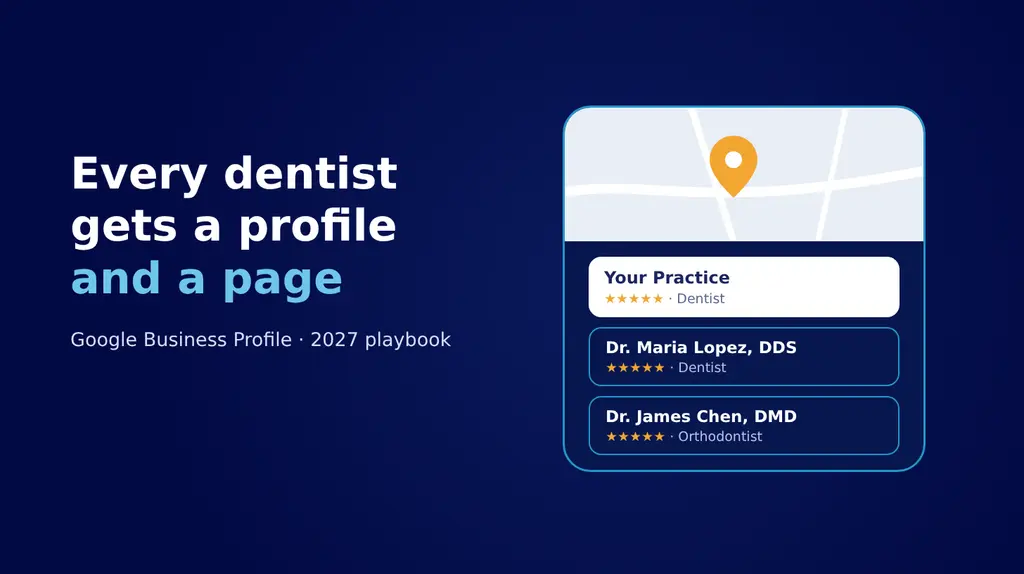
Each dentist can have their own profile
Most dentists don't know this. Google treats doctors and dentists as "individual practitioners," and a dentist who sees their own patients can have a dedicated profile at the practice, separate from the practice's own profile.3
The rules are short:
- The practice keeps its own profile for the location.
- Each dentist's profile uses their name only, with credentials if you like ("Dr. Maria Lopez, DDS"). No practice name in it.
- One profile per dentist. Not one for each specialty.
- They have to be reachable at that office during the hours on the profile. Support staff don't get one.
One catch: if you're the only dentist in the practice, Google wants one shared profile, named like "Practice Name: Dr. Name," not two.3 This playbook is for practices with two or more dentists.
Why bother? Because patients search for the person. "Dr. Lopez dentist" and "orthodontist near me" are different searches, and a dentist with their own profile, their own category and their own reviews gives Google a better match for both. Local SEO expert Joy Hawkins notes that practitioner profiles work best when each one targets something different, like a general dentist and an orthodontist, rather than all chasing the same search.4
The page each profile links to
Here's the piece most practices skip. Every dentist's profile needs a website link, and it shouldn't be your homepage. Your practice profile already links there.
Best practice: link each dentist's profile to their own page on the practice website. Darren Shaw of Whitespark has recommended this for years: one page per practitioner, about that person and their specialty, mentioning the city, with enough content to help that profile rank. If you don't have one, build one.5 In Whitespark's 2026 survey, the title tag and headings on the page your profile links to both ranked in the top 20 factors for map rankings.2
That one page is the location page, the service page and the doctor's page all in one. Here's what we put on it:
- Name, credentials and a real headshot. Not a stock photo.
- The practice's address and phone number, written exactly as they appear on the profile.
- The services this dentist actually does, with links to your pages for each one.
- Their background: dental school, specialty training, memberships, languages spoken.
- Location context: the neighborhood and the towns your patients come from.
- A booking button, ideally one that books with that dentist.
- A short FAQ in that dentist's voice: what a first visit with them is like.
What about a personal brand website? It's fine to have one, and the dentist page can link to it. But while they practice at your office, their profile should point to the page on your site. That's the page that matches the address, phone and booking on the profile, and it's the one that ties them to the location in Google's eyes.
Who should own each dentist's profile?
This is the question that causes the fights later. If you take one thing from this article, take this: decide ownership in writing before the profile goes live.
Whoever controls a practitioner profile decides what happens to it when the dentist leaves. If the dentist controls it, they can update it to their new office, and the reviews go with them. If the practice controls it, it can ask Google to remove it.4 Darren Shaw points out that, from Google's point of view, a practitioner profile is about the person.5 That's why the reviews a dentist earns tend to follow them.
Here's the setup we recommend:
- The practice owns its own location profile. Always. That's the practice's asset, and it never leaves.
- Each dentist is the primary owner of their own profile, on a Google account they control.
- The practice and your marketing team are added as managers. Managers can update info, post, add photos and respond to reviews, but can't remove the owner or delete the profile.6
- Nobody else is primary owner. Including your agency. That includes us.
- Write down what happens if they leave: the dentist updates their profile to their new office and new link, and the practice takes down their page and points it to your team page. Never rename a departing dentist's profile for someone new.
Not ready to hand an associate their own profile? Start with the dentists least likely to leave: owners, partners, long-time associates. Hawkins recommends exactly that.4
How to set up a dentist's profile, step by step
Have your web team build the dentist's page first, so you have the link ready.
- Check whether a profile already exists. Search the dentist's name and city on Google Maps. Google sometimes creates profiles on its own, and old offices sometimes leave them behind. If one exists, claim it instead of making a new one. Duplicates cause trouble.
- Sign in with the right Google account. Use the dentist's own professional Google account, not a shared front-desk login. Google says each person who manages a profile should have their own Google account.6
- Add the profile at business.google.com/add (or tap "Claim this business" on an existing one).7
- Name: the dentist's name and credentials only. Category: the most specific one that fits, like Dentist, Orthodontist or Periodontist. Address: the practice address, formatted exactly like the practice profile. Hours: the hours they actually see patients. Website: their page on your site.
- Verify. Google chooses the method (it may be a short video) and sometimes asks for more than one.7 Do it from the office, during office hours.
- Add the practice and your marketing team as managers.
- Fill it in completely: headshot, office photos, a description in plain words (no links or promotions; Google doesn't allow them in the description3), and the services they offer.
Weaponize it: the weekly routine
Setup is a one-time job. Here's what keeps a profile working, in order of importance.
Reviews: ask every patient, every time
Reviews do the heavy lifting, and freshness matters most. Recent reviews and a steady flow of them over time both ranked in the top 15 map factors in Whitespark's 2026 survey.2 And patients notice: most only trust reviews from the last three months.1
The good news: just asking works. In BrightLocal's 2026 survey, 83% of people who were asked to leave a review went on to leave one.1
Google's review rules got stricter in 2026. Here's what's allowed and what isn't.8
- ✅ Ask every patient for an honest review.
- ✅ Send each patient the link to the profile of the dentist they saw. This is the clean way to build reviews for each doctor.
- ❌ Don't ask patients to mention a dentist or staff member by name, or to include anything specific. Google now spells this out.
- ❌ Don't pressure patients to review while they're still in the office. Skip the review tablet at checkout.
- ❌ Don't offer anything in return: no discounts, no raffle entries.
- ❌ Don't only ask the patients you think are happy.
Our Authority Engine handles the ask for you. By default it sends every patient a review request, so you're not relying on a busy front desk to remember. Ask us about it.
Respond to every review, carefully
Patients expect replies, and most are more likely to choose a business that responds to every review.1 But this is where dentists get into trouble. HHS fined a Texas dental practice $10,000 for revealing patient details in replies to online reviews, and its civil rights director said dentists must think carefully about patient privacy before responding.9
The rule of thumb: thank them warmly, never confirm they're a patient, never mention treatment, and take anything negative offline ("Please call our office manager so we can make this right"). See our guide to responding to negative reviews for wording that works.
Posts: weekly, but for the right reason
We still recommend a weekly post. Just be honest about why. In Whitespark's 2026 survey, experts ranked posting frequency 148th of 187 factors for map rankings.2 Posts won't move you up on their own.
What they do is show patients a practice that's open, active and human, and give Google's AI fresh, accurate information to work with. Rotate a few easy ones: meet the doctor, a common patient question answered, a team photo, an office update.
The basics that quietly matter
- Keep hours right, including holidays. Being open at the time of the search ranked fifth of 187 factors.2
- Add real photos every month. Your team, your rooms, your building. No stock or AI-made images.
- Keep services current on each dentist's profile. Google's built-in service list ranked in the top 25.2
What's different in 2027: Google's AI answers for you
The Q&A section on Google profiles is gone. In its place, Google Maps now lets patients ask questions about your practice and get an instant AI answer built from what Google knows about your practice, including your reviews.10
You can't write those answers anymore. You can only make sure the source material is right. So once a month, open Google Maps, find your practice and each dentist, and ask what a patient would: "Do they take my insurance?" "Do they do implants?" "Are they good with kids?" If an answer is wrong or thin, fix it at the source: the profile, the dentist's page, or the FAQ on your website.
This is also why the dentist pages matter so much. They're what the AI reads. And with 45% of consumers now using AI tools for local recommendations,1 the practices with clear, complete pages are the ones those tools can describe. Our guide on getting found in ChatGPT covers the rest of the AI side.
The honest limits
- Reviews get split. Some patients will review the dentist instead of the practice. A patient can review both, but you're asking more of them.4
- You won't own the whole map. Google filters out multiple listings tied to the same website for the same search, so three profiles won't get you all three spots.4 Different dentists ranking for different searches is the realistic goal.
- People leave. That's why ownership comes first.
- It isn't a one-time project. A dentist profile with five reviews from 2024 doesn't help anyone. Nearly half of consumers won't use a business with fewer than 20 reviews,1 so plan for a steady flow from day one.
Help patients find the right doctor
Patients like knowing who they're seeing before they arrive. Introduce each dentist with a post on your Google profile and social pages, add their page to your website menu, and send the right dentist's profile link in your post-visit messages. When a new dentist joins, that's a post, a page and a profile in the same week.
Share this with your office manager. They're the one who'll keep it running. The share buttons are at the top and bottom of this page.
What to do this week
- Search each dentist's name and city on Google Maps and write down what you find, including old profiles you didn't know existed.
- Decide ownership for each dentist and put it in writing.
- Ask your web team for a page per dentist using the checklist above.
- Set up or claim one profile, starting with the dentist least likely to leave.
- Turn on review requests that go to every patient, with the right dentist's link.
Want this done for you?
You've been meaning to do this. Most dentists have. Between patients, staff and the business itself, it keeps sliding, and that's exactly what an agency is for.
Start with a free instant audit of your website. Enter your site and email below and you'll get a report on the technical basics that affect whether patients, Google and AI tools can find your practice.
Want us to set up and run your practice and doctor profiles? Book a call and we'll show you where your practice stands and what we'd do first.
Profile setup, dentist pages and review growth are part of our dental SEO plans, which come with a minimum 100% ROI guarantee: if we don't hit it, we keep working until we do.
This article is general information, not legal or HIPAA advice. Google's rules change; check its current guidelines before you set up a profile.
Footnotes
-
BrightLocal, Local Consumer Review Survey 2026, February 2026 (survey of 1,002 U.S. adults; BrightLocal sells local SEO software). ↩ ↩2 ↩3 ↩4 ↩5 ↩6
-
Whitespark, Local Search Ranking Factors 2026, November 2025 (survey of 47 local search experts scoring 187 factors; Whitespark sells local SEO software). ↩ ↩2 ↩3 ↩4 ↩5 ↩6
-
Google Business Profile Help, Guidelines for representing your business on Google (see "Individual practitioners"). ↩ ↩2 ↩3
-
Joy Hawkins, Sterling Sky, The Ultimate Guide to Practitioner Listings, updated February 2026. ↩ ↩2 ↩3 ↩4 ↩5
-
Darren Shaw, Whitespark, How to handle practitioner listings in Google My Business and your citations. ↩ ↩2
-
Google Business Profile Help, Manage your Business Profile owners and managers. ↩ ↩2
-
Google Business Profile Help, Add or claim your Business Profile and Verify your business on Google. ↩ ↩2
-
Google Maps User Generated Content Policy, Prohibited and restricted content (see "Rating manipulation"). ↩
-
U.S. Department of Health and Human Services, Dental practice pays $10,000 to settle social media disclosures of patients' protected health information, October 2019. ↩
-
BrightLocal, Goodbye Google Q&A: It's time to Ask Maps, April 2026. ↩