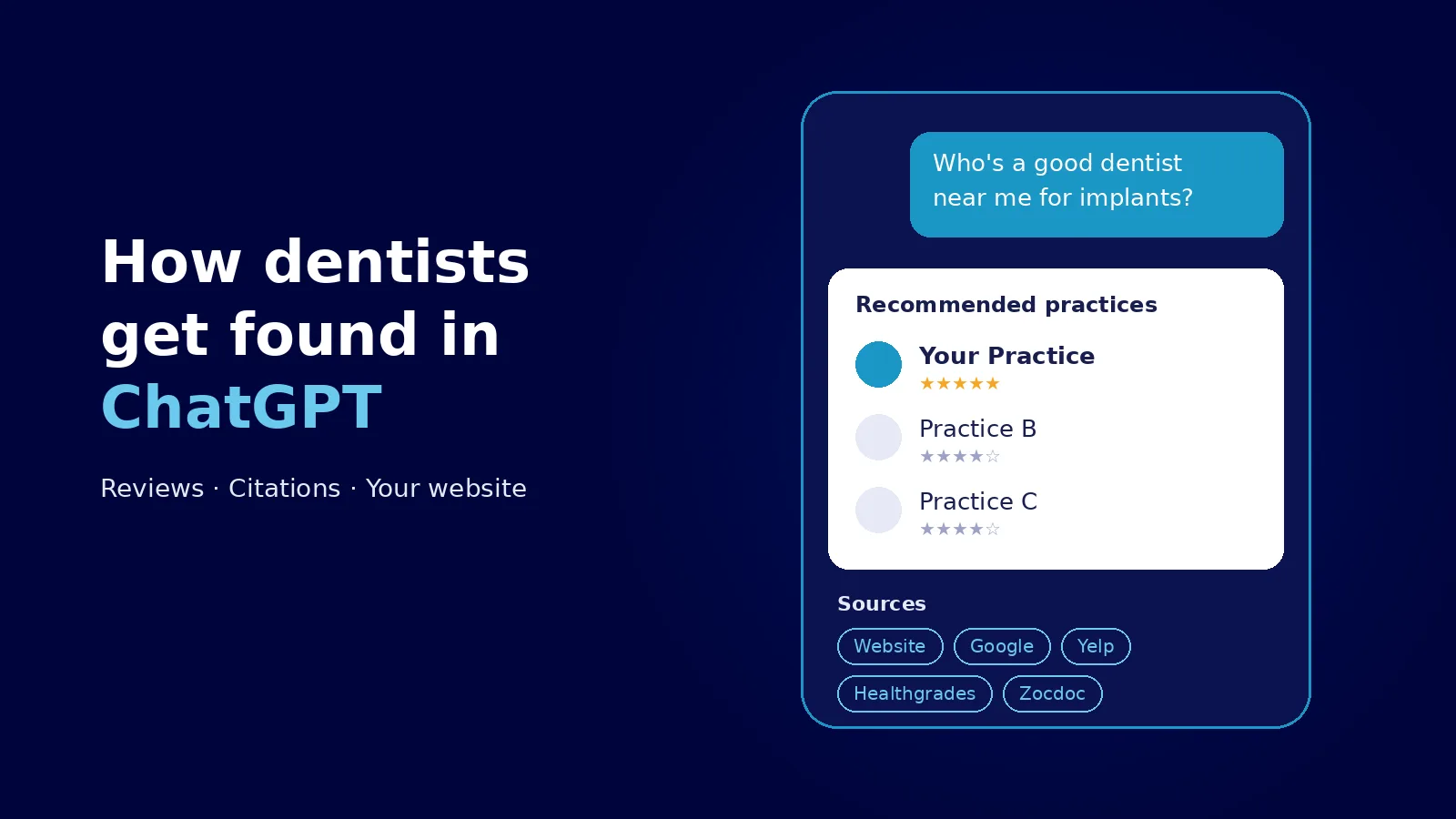
A new patient in your town types into ChatGPT: "Who's a good dentist near me for implants?" ChatGPT answers with three or four practices, a line about each, and a short list of sources. If your practice isn't in that answer, that patient may never see your website at all.
This guide shows you how to get found in ChatGPT as a dentist. Not with tricks, but by understanding exactly where ChatGPT gets its information about local practices, and fixing what it finds.
This isn't a niche habit anymore. In BrightLocal's 2026 survey of 1,002 US adults, 45% of consumers used AI tools for local business recommendations, up from 6% the year before. ChatGPT led the way: 31% had used it for a business recommendation in the past 12 months.
Where ChatGPT gets its information about dentists
ChatGPT doesn't have a secret list of "best dentists." When a patient asks for a recommendation, it searches the web, reads what it finds, and summarizes. So the question is really: what does it find when it looks you up?
In an earlier BrightLocal study of 800 local searches in ChatGPT, 58% of the sources were business websites, 27% were mentions of the business on other sites, and 15% were directories. Those are your three levers.
BrightLocal's larger 2026 study of nearly 2 million AI citations broke the numbers out for dentists. Across Google's AI results and ChatGPT combined, these were the most-cited sources for dental practices:
| Source | Share of dentist citations |
|---|---|
| Google Business Profile | 57% |
| Yelp | 15.4% |
| 1.9% | |
| Zocdoc | 1% |
| Healthgrades | 0.5% |
| MapQuest | 0.4% |
| Delta Dental | 0.4% |
Source: BrightLocal, "Top sources and directories for local AI search" (2026). Google Business Profile is the main source for Google's own AI tools.
Here's the part most dentists miss. When the same study looked at ChatGPT on its own, Yelp appeared as a source in 80% of its local answers, while Google Business Profile wasn't a top source at all. BrightLocal's CEO put it plainly: tools like ChatGPT can't see inside Google's review system, so a reputation that lives only on Google is close to invisible there.
If you've spent years building Google reviews, keep going. They still drive Google. But for ChatGPT, they're only part of the picture.
Step 1: Make sure ChatGPT can actually read your website
ChatGPT uses its own crawler, called OAI-SearchBot, to find pages for its search answers. OpenAI says plainly that sites that block OAI-SearchBot won't be shown in ChatGPT search answers, and it recommends allowing it in your site's robots.txt file.
Some website platforms and security plugins block "AI bots" with one checkbox, and that can quietly block search along with them. Ask your web team two questions:
- Is OAI-SearchBot allowed in our robots.txt? OpenAI notes changes can take about 24 hours to take effect.
- Are we blocking GPTBot? That's a separate crawler used for AI training. You can block it without affecting your ChatGPT search visibility, because each setting works independently.
Then make sure each page says what ChatGPT needs to know, in plain text: your practice name, address, phone, the town you serve, and one page per major treatment. A page that just says "We offer a full range of services" gives an AI nothing to quote. If your current site makes this hard, that's what our high-performance dental websites are built to fix.
Step 2: Build reviews beyond Google
Think "reviews everywhere," not "reviews on Google." Based on the dentist data above, the sites that matter most after Google are Yelp, Facebook, Zocdoc and Healthgrades.
Yelp needs special care. Yelp's guidelines tell businesses not to ask customers for reviews, and its software may filter reviews that look prompted. So on Yelp:
- Claim your free business page and fill in every field: hours, services, photos, insurance accepted.
- Respond to every review, good and bad.
- Let patients know you're on Yelp (a window sticker or a link on your website), without asking them to leave a review.
On Google and Healthgrades, you can ask. (Zocdoc reviews generally come from patients who booked through Zocdoc.) When you ask, invite patients to mention what they came in for and how the visit felt. A review that says "my implant consult was clear and painless" tells ChatGPT far more than "great dentist!" Never script the wording or offer anything in return. Our 4 simple steps to collect more 5-star reviews walks through a system your front desk can run.
Reply carefully. Patients do check: 97% of AI users sometimes double-check AI recommendations against real reviews. Your replies are part of what they read. Never confirm someone is a patient or mention treatment details in a public reply. Here's how to respond to negative reviews without creating a privacy problem.
Step 3: Clean up your citations
A citation is any listing of your practice's name, address and phone number. When ChatGPT finds the same details everywhere, it can trust them. When it finds an old address on one site and a different phone number on another, it has reasons to hesitate.
Start with the listings that showed up in the dentist data: Google Business Profile, Yelp, Facebook, Zocdoc, Healthgrades and MapQuest. Then add Apple Business Connect (Apple Maps), Bing Places, and the "find a dentist" directories of the insurance networks you accept. Delta Dental's directory showed up in the dentist citation data on its own.
Make every listing match exactly, down to "Suite 200" versus "Ste. 200." Our guide to optimizing your dental Google Business Profile covers the fields that matter most, and the same habits carry over to every other listing.
Step 4: Answer the questions patients ask ChatGPT
Patients don't type "dentist" into ChatGPT. They ask full questions: "Does dental implant surgery hurt?" "Is there a dentist in [your town] who does sedation for anxious patients?" "How much do Invisalign aligners cost without insurance?"
ChatGPT favors pages that answer questions like these clearly and specifically. For each core treatment, your website should cover:
- What the treatment is and who it's right for
- What to expect during and after, in plain language
- A realistic price range or how pricing works, plus insurance and financing
- Who on your team performs it, with their credentials
- The towns and neighborhoods you serve
A well-built FAQ section is one of the easiest ways to do this. Specialists should go further: our guide on optimizing for specialty keywords applies directly to how orthodontists, endodontists and periodontists get recommended.
Step 5: Get your practice mentioned where your town talks
Remember that 27% from the ChatGPT study: mentions of a business on other websites made up more than a quarter of sources. These are the places a real local reputation shows up online:
- Local news stories and community event pages
- Sponsorships (youth sports, school fundraisers, charity runs)
- Your state or local dental society
- The chamber of commerce and local business groups
- "Best of" lists from local publications
Each mention is another place ChatGPT can confirm you exist, where you are, and what you're known for. These are also the local backlinks that help your Google rankings, so the same effort pays twice.
Run the 10-minute ChatGPT test on your practice
You don't need special software to see where you stand. Open ChatGPT and ask the questions your ideal patients would ask. For example:
- "Who's the best dentist in [your town]?"
- "I need a dental implant near [your town]. Who should I see?"
- "Which dentist near [your neighborhood] is good with anxious patients?"
- "Is [your practice name] a good dentist?"
- "What do patients say about [your practice name]?"
For each answer, write down three things: whether your practice is named, which sources ChatGPT lists, and whether what it says about you is accurate. Answers can change from one day to the next, so run the test again monthly and look for the trend, not one result.
Then measure the real traffic. OpenAI says ChatGPT automatically adds utm_source=chatgpt.com to links it sends to your site, so you can see those visits in Google Analytics. Watching that number grow is how you'll know this work is paying off. Our guide to measuring SEO ROI shows how to tie those visits to booked appointments.
What not to do
- Don't buy or fake reviews. Every major review platform prohibits it, and patients double-check.
- Don't pay for "ChatGPT ranking" hacks. No one can guarantee placement in an AI answer. Anyone who promises a spot in ChatGPT is selling something they can't control.
- Don't abandon Google. Google Business Profile is still the most-cited source for dentists across AI search overall, and local SEO is still the foundation everything else stands on.
ChatGPT visibility isn't a separate project from good dental marketing. It's the same work, done everywhere patients and AI tools look, not just on Google. For more on how search shifted this year, see the biggest SEO changes dentists faced in 2026.
See how your practice shows up online
Start with a free instant audit of your website. Enter your site and email below and you'll get a report on the technical basics that affect whether search engines and AI tools can read your practice's site.
Want a second set of eyes on the results? We'll walk through your website, reviews and listings with you, and show you where the gaps are for both Google and ChatGPT.
Our dental SEO plans cover all five steps in this guide: website, reviews, citations, content and local mentions, managed for you.
Sources
- BrightLocal, Nearly Half of Consumers are Asking AI for Business Recommendations (March 2026)
- BrightLocal, Top sources and directories for local AI search (August 2026)
- BrightLocal, Uncovering ChatGPT Search Sources
- BrightLocal, Review platform guidelines
- OpenAI, Overview of OpenAI crawlers
- OpenAI, Publishers and Developers FAQ