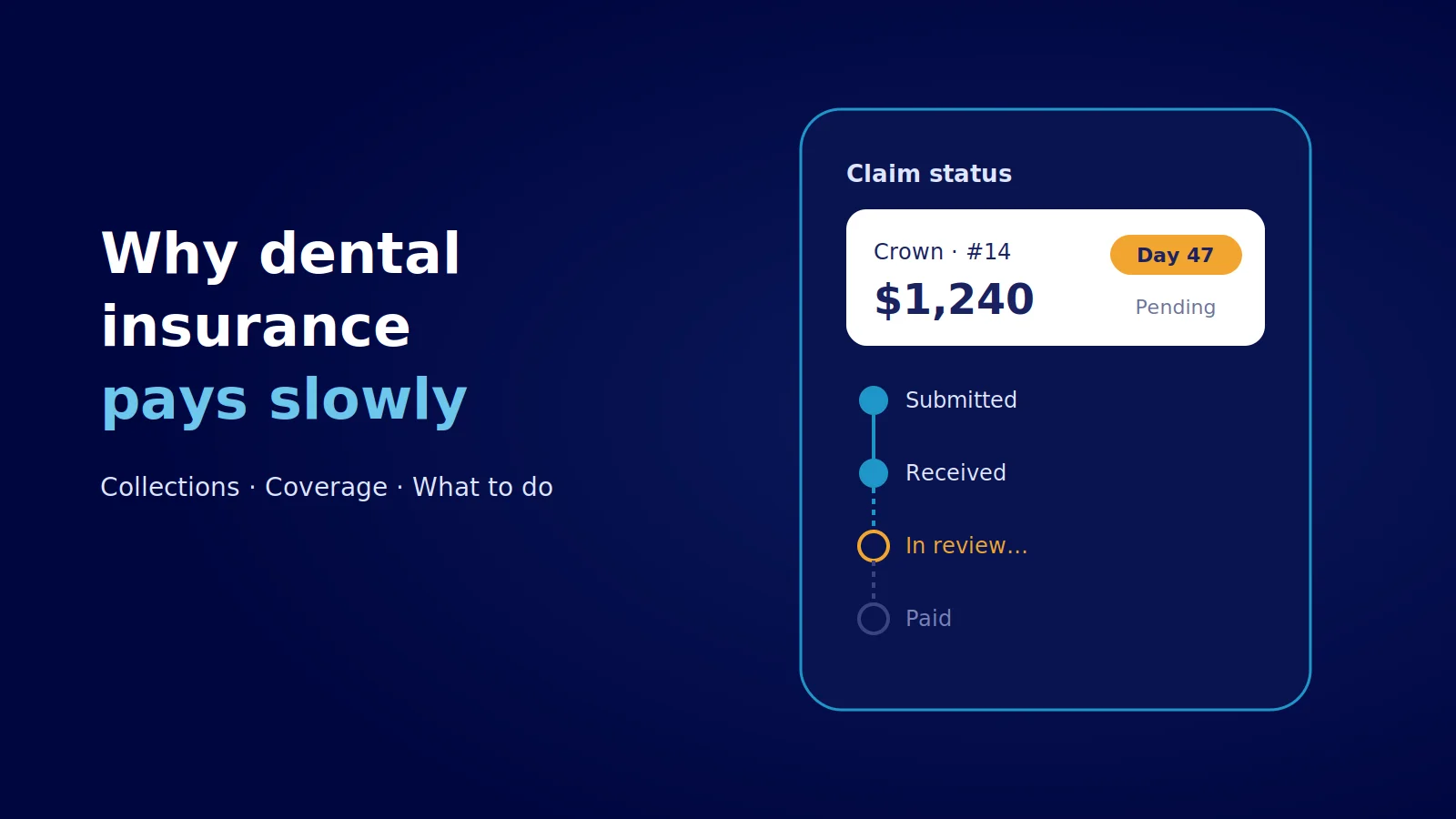
You did the work. The crown is seated, the patient is happy, and the claim went out the same day. Six weeks later it's still "in review," or it comes back denied for a missing narrative. Meanwhile payroll, lab bills and rent are due on time, every time.
If dental insurance collections feel harder than they used to, you're not imagining it. Reimbursement has been flat for years, carriers are scrutinizing more claims, and the plans themselves were designed for prices from another era. The good news is that a lot of the pain is fixable. This guide covers why it's happening, then a two-part plan: tighten up billing first, then make your practice less dependent on insurance over time.
Dental insurance by the numbers
50%+
of dentists named insurance, including delayed or denied payments, a top concern for 2026
ADA Health Policy Institute, 2025 poll1
7%
of dentists got an insurance reimbursement increase in 2022, as practice costs rose
ADA Health Policy Institute, 20222
78%
of dental billing professionals in a 2026 industry survey reported more denials or payer scrutiny
Zentist industry survey, 20263
3.4%
of dental patients reached a typical annual benefit maximum
ADA Health Policy Institute, 2024 analysis4
30 days
to pay or deny a clean electronic claim under New Jersey's prompt-pay rules (Washington uses a similar standard)
NJ DOBI, WSDA5
33%
of dental claim payments were made by electronic funds transfer (direct deposit)
2025 CAQH Index7
Why dental insurance collections keep getting harder
Three things are working against you at once.
Reimbursement hasn't kept up. Supplies, wages and rent have all gone up, but in the ADA's 2022 poll most dentists said their insurance fees had stayed flat or gone down. The ADA has been blunt that it can't negotiate rates for individual practices, and that the real lever dentists have is deciding which plans they participate in.12
More claims are getting a second look. Dental billing professionals surveyed in 2026 reported more denials and payer scrutiny, and said it mostly comes down to how carriers read "medical necessity" and frequency limits: the cleaning that came a week too early, the crown on a tooth that had one eight years ago, the narrative that wasn't attached.3 Every one of those is a claim that sits, comes back, and gets worked twice.
The plans were never built for today's dentistry. The familiar design is 100% for preventive care, 80% for basic and 50% for major work, with annual maximums that haven't kept pace with inflation. Many plans still promote the $1,000 level that was set some 40 years ago. Some plans now push procedures into lower tiers or pay as little as 20% on major work.4 The ADA adopted a policy in 2024 opposing annual maximums altogether, but for now that's the system your patients are on.
How long carriers have to pay you
There's no single national deadline, but many states set one, and many offices don't use it. In New Jersey, for example, a clean claim has to be paid or denied within 30 days if it's sent electronically and 40 days on paper, and late payments can owe interest.5 Washington uses a similar 30-day standard.
Two words in that rule matter more than the number. "Clean" means complete and correct: the clock doesn't really start until the carrier has everything it needs, so a missing X-ray quietly resets your wait. "Electronically" means paper claims get extra time by law. Rules vary by state and by plan (self-funded employer plans may follow federal rules instead), so check with your state dental association before quoting a deadline to a carrier.
What patients actually end up paying
A lot of collection pain is really expectation pain. The patient thought insurance would cover more than it did, and you find out when the bill goes out.
Here's an illustrative example (not real fees). Your fee for a crown is $1,400 and the plan's allowed amount is $1,000. At 50% coverage, the plan pays $500 of the allowed amount. If you're in network, the patient typically owes the other $500 plus any deductible, and the $400 above the allowed amount is written off under your contract. If you're out of network, the patient may owe some or all of that $400 too, depending on the plan and your state's rules. If nobody explains that before treatment, you're collecting it afterward, which is the hardest money there is to collect.
And cost already keeps people out of the chair. Dental care has the highest cost barrier of any kind of health care, with adults far more likely to skip the dentist over cost than to skip a doctor's visit.6
Part 1: Tighten up billing so claims get paid faster
These are the fixes that pay off this month.
- Verify every patient before the visit, not at check-in. Check eligibility, remaining maximum, deductible, frequency limits, waiting periods and missing-tooth clauses. This step can help prevent many avoidable denials.
- Send clean claims, electronically, the same day. Attach X-rays, perio charts and narratives up front for anything beyond preventive care.
- Get paid by direct deposit, not check. Enroll in electronic funds transfer (EFT) with every carrier. Nacha, which runs the ACH network, says practices can turn down virtual credit cards and insist on EFT.7
- Work the aging report every week. Anything over 30 days gets a call or a portal check. If a clean claim is past your state's deadline, say so, and ask about the interest owed.
- Appeal instead of writing off. Read the reason code, fix what's fixable and resubmit with documentation. Track your top three denial reasons each month and fix the step that causes them.
- Give patients a written estimate before treatment, and collect their share at the visit. Patient balances get harder to collect every week they sit.
- Review your PPO fee schedules once a year. Know which plans pay you the least for the most work. The ADA offers a contract negotiation guide to help.2
Part 2: Rely less on insurance over time
Billing fixes help you collect what you're owed. They don't change what you're owed. Building a larger base of patients who don't run through a PPO can help reduce how much your practice depends on insurance reimbursements.
Offer an in-office membership plan. Patients pay your practice a set monthly or yearly fee for preventive care and get a discount on everything else. No claims, no maximums, no waiting on a carrier. In a 2023 ADA poll, about a quarter of practice owners already offered one, and plenty more were considering it.8 It's a natural fit for the roughly one in four Americans with no dental insurance.6 Check your state's rules on prepaid plans before you launch.
Help patients push their employers. Employers choose the plan design, and most never hear that the annual maximum is delaying their employees' care. The ADA encourages dentists to suggest patients raise it with HR, especially around open enrollment.4
Drop your worst plan, carefully. Before leaving a network, count how many active patients are on it, what it pays compared with your full fee, and how many of those patients you could keep with a membership plan. Then give patients plenty of notice and a clear way to stay.
Build a steady flow of fee-for-service new patients. This is the part that's easiest to skip. If almost every new patient finds you through an insurance company's "find a dentist" list, you'll always depend on that insurance company. Patients who find you on Google, Google Maps or ChatGPT, read your reviews and choose you for you came to you independently of an insurer's list. In our view, they're often more open to a membership plan or to fee-for-service treatment like implants or Invisalign.
That's where marketing stops being a cost and becomes part of your insurance strategy: a website that answers patients' questions about cost, membership plans and payment options, and local SEO that puts you in front of people searching for the treatments you most want to do. Our guide on measuring SEO ROI shows how to tie that work to booked appointments.
Educate patients before the bill does
Most insurance frustration lands on your front desk, but it starts with a patient who never understood their plan. The more your patients know before treatment, the fewer surprised phone calls, unpaid balances and bad reviews you deal with afterward. And patients take it better coming from their dentist than from an explanation of benefits in the mail.
Explain it in plain English, chairside. When you present treatment, walk through three things: what the plan usually covers, what an annual maximum is, and what their share will likely be. Then hand them the written estimate. Give your team a simple one-page script so everyone explains it the same way.
Put the answers on your website. Patients are already searching questions like "what does my dental insurance cover," "what is an annual maximum" and "do my dental benefits expire." A blog post or FAQ page that answers those questions for your office does two jobs at once: it educates the patients you have, and it helps new patients find you on Google and in AI search. Good topics to start with:
- How dental insurance works at our office
- What an annual maximum is, and why your plan stops paying
- In-network vs. out-of-network: what it means for your bill
- Our membership plan, for patients without insurance
- Use your benefits before they reset (many plans reset every January)
Share it where patients already are. Post those articles to your practice's Facebook and Instagram, link them in appointment reminder texts and emails, and send a "use your benefits before year-end" reminder every fall. One well-written post can be shared again every year.
Don't stop at your patients. If this article helped, pass it to a colleague or your office manager. The share buttons are at the top and bottom of this page.
What to do this week
- Pull your aging report, list every claim over 30 days old and call on the five biggest.
- Check your EFT enrollment with your top three carriers and switch any still paying by check or virtual card.
- Look up your state's prompt-pay rule and put the deadline on the front-desk cheat sheet.
- Count your patients by plan. The plan that pays you least is the one to renegotiate, replace with a membership plan, or plan your exit from.
- Write one patient-friendly post on how insurance works at your office, and share it on your practice's social pages before year-end.
Want more patients who choose you, not their insurance company's list?
Start with a free instant audit of your website. Enter your site and email below and you'll get a report on the technical basics that affect whether patients, Google and AI tools can find your practice.
Want help turning your website into a source of fee-for-service patients? Book a call and we'll show you where your practice stands and what we'd do first.
Our dental SEO plans include ongoing content development, so patient-education posts like these can be written for you. Our SEO plans and dental websites come with a minimum 100% ROI guarantee: if we don't hit it, we keep working until we do.
This article is general information, not legal or billing advice. Insurance rules vary by state and plan.
Footnotes
-
ADA News, Dear ADA: Reimbursement rates, January 2026 (ADA Health Policy Institute poll, late 2025). ↩
-
ADA News, HPI poll: Insurance reimbursement not keeping up with practice operating costs, September 2022. ↩ ↩2
-
Becker's Dental + DSO Review, 78% of dental offices see uptick in claim denials, on Zentist's 2026 survey of 160+ dental billing professionals. ↩
-
ADA News, Dear ADA: Annual maximums, December 2025. ↩ ↩2
-
New Jersey Department of Banking and Insurance, Prompt Pay Regulations FAQ; Washington State Dental Association, Dealing with delayed dental claims, July 2026. ↩
-
Becker's Dental + DSO Review on the ADA Health Policy Institute's September 2026 report: cost barriers and coverage. ↩ ↩2
-
Nacha, Dental practices shifting to EFT claim payments, March 2026, on the 2025 CAQH Index. ↩
-
Becker's Dental + DSO Review, More than 25% of practices offer in-office dental plans, August 2023, on an ADA Health Policy Institute poll of 874 owner dentists (July 2023). ↩